Moscow + 7
The Trans-Siberian Railway

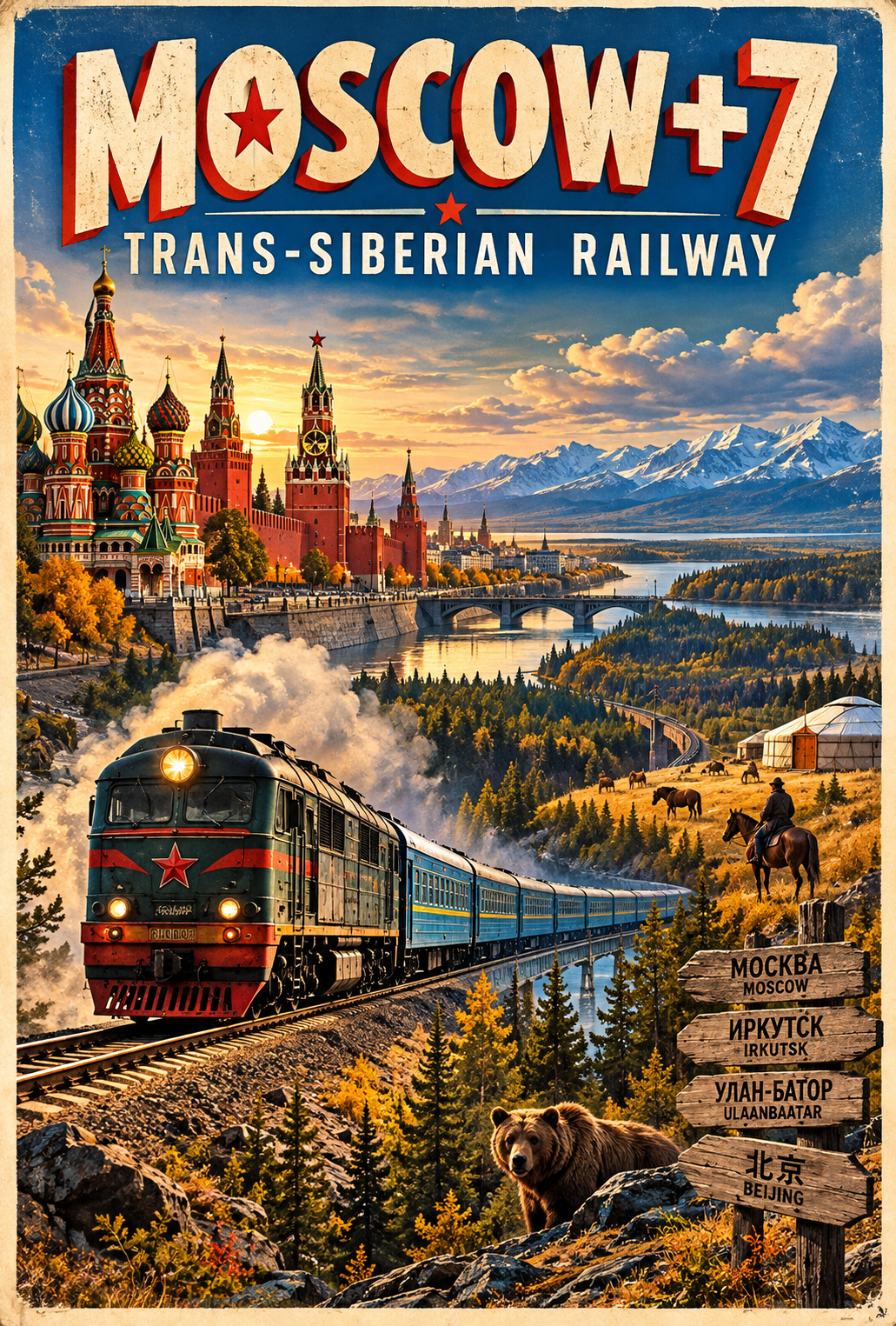
Moscow + 7 — The Trans-Siberian Railway
Announcements for lost passengers, missing children and unattended luggage ricocheted from the high ceilings of Heathrow Terminal 3.
Sean and I were waiting for Dad.
He was flying in from Thailand. We had arrived from Belgium that morning, still carrying the previous week on us: partially bearded, underslept, vaguely fragrant, and exhilarated from having driven Germany’s Autobahn at 200 kilometres an hour in a car better suited to recycling than velocity.
We had nearly killed ourselves three times.
I recommend the Autobahn highly for anyone suffering from speed-limit fatigue.
Then the arrivals doors opened and there was Dad.
Freshly shaved. Smartly dressed. Vest. Alert eyes.
He looked nothing like us.
We exchanged savage hugs. Dad was emotional; this journey had been living in his imagination for more than twenty years.
“If you hug me any longer,” I told him, “I’m going to have to charge you my hourly rate.”
He broke away, slapped his knees and asked where he could find a proper washroom.
We found one inside an expensive steak restaurant, where we accepted menus with absolutely no intention of ordering anything. Dad produced a toner-scorched fax from his bag.
This was our itinerary.
The final version had arrived only two days earlier.
“Moscow—two nights,” he read. “Train for four days. Irkutsk. Then Mongolia. Three nights in Ulaanbaatar. Another night on the train. Beijing for a week.”
We bumped fists.
This was before people bumped fists.
⸻
Twenty-three years earlier, Dad had stood inside the Hermitage Museum in Leningrad talking to two young British travellers.
It was 1974.
I was five.
My parents had won an Air Canada contest and, given their choice of destinations, selected the Soviet Union because it was about as far from home as Air Canada could take them. We missed our connecting flight to Leningrad.
That aircraft crashed.
Everyone aboard was killed.
Mom, Dad and I caught the next flight.
Apparently this did nothing to discourage my parents from travelling.
At the Hermitage, while five-year-old me was being dragged past the bottoms of paintings I was too short to properly see, Dad met those two Englishmen. They had just crossed the Soviet Union by train from Peking.
The Trans-Siberian Railway.
Dad loved trains, particularly steam trains, and immediately imagined taking his own family across Russia someday.
One of the travellers offered him a piece of advice he never forgot:
“You’d be a fool not to do it once. You’d be a bloody fool to do it twice.”
Twenty-three years later, Dad had apparently decided to test the first half of the proposition.
And he was taking his sons with him.
⸻
That was not necessarily an obviously good idea.
I was twenty-seven. Sean was twenty-four. Dad was forty-eight.
Our parents had separated years earlier under circumstances sufficiently complicated that Sean and I had spent some time blaming each other for them. Dad had lost some of the automatic authority that comes with fatherhood. Whatever relationship remained between the three of us had been reconstructed piecemeal.
And now we proposed locking ourselves together on a train for nine days.
Across Russia.
Would Dad become Dad?
Would Sean and I become twelve again?
Would somebody be abandoned in Omsk?
These were legitimate questions.
We discussed them over lasagna and wine at Neighbours Restaurant back home. Organizing the journey was extraordinarily difficult. This was barely the Internet age. Our travel agent had a fax machine and, by the end of the arrangements, reportedly weighed eight pounds less.
Eventually the three of us looked across the table at one another.
Done.
We were doing it.
None of us knew this journey would become the first of several enormous trips together.
At the time, there was only this one.
Moscow to Beijing.
Nine thousand kilometres of railway.
And whatever happened between departure and arrival.
⸻
That night in London, Dad generously paid for the hotel.
His room was approximately three stars superior to the luggage-storage facility assigned to Sean and me.
Jet lag put everyone to bed early and woke us again around three in the morning. We ventured outside expecting London nightlife and discovered that London, contrary to reputation, occasionally sleeps.
So we went to Tesco.
There we purchased enough provisions to survive whatever culinary apocalypse we imagined awaited us east of Poland: fruit, water, soup, cheese and anything else we’d been warned might become unobtainable once we entered the folkloric wilderness of Russian cuisine.
Everything went into one enormous duffel.
We named it the food bag.
There were now seven pieces of luggage.
We would count them compulsively for the rest of the journey.
We carried our lives.
⸻
The next morning our taxi driver listened as we explained where we were going.
Moscow.
Siberia.
Mongolia.
Beijing.
He seemed less disturbed by the geography than by the fact that the three of us were related.
“I work two jobs so I don’t have to see me family!”
Fair point.
Then he began explaining communism to us.
Apparently Russians drove on the wrong side of the road and taxi drivers were being paid in beetroot and tampons.
“That’s commie thinking, ya know.”
He tapped his temple.
“They don’t think like we do.”
Within a few hours, we would be among them.
The aircraft accelerated down the runway and Britain fell away beneath us.
Dad opened his notebook and disappeared into writing. Sean changed the batteries in his Walkman.
I went looking for Russians.
At the back of the aircraft I found them inside a cloud of cigarette smoke.
This was still an era when you could smoke on an international flight, an arrangement that now seems roughly as sensible as installing a campfire beside the oxygen masks.
I sat beside a Russian oil executive named Sergei.
When I told him we were stopping in Irkutsk, he smiled.
“The Paris of Siberia.”
I looked at him.
“Is that beautiful in a Parisian sense or a Russian one?”
“A personal one.”
I pointed toward a flight attendant.
“Is she beautiful?”
Sergei considered this carefully.
“She is cute.”
“So we’re on the same wavelength. I think she’s cute too. But not beautiful.”
He extinguished his cigarette.
“Irkutsk is therefore beautiful in a traditional Russian sense.”
Then he stood.
“Do svidaniya.”
And disappeared.
I liked Russians already.
⸻
Hours later the landing gear came down.
Through the window appeared a world almost entirely without colour.
Cloud.
Concrete.
Dirty snow.
Hangars.
Rain streaking sideways across the glass.
Then the wheels slammed into the runway and the entire cabin erupted into applause.
Perhaps because we had landed.
Perhaps because we had landed on the runway.
Either way, we had arrived.
Sheremetyevo Airport.
Moscow.
Russia.
And somewhere beyond that terminal, stretching eastward farther than any railway on Earth, were the tracks that would carry the three of us across a continent.
We only had to get through Russian customs first.
That took three hours…