
The Future of Driving: An Unnecessary Bravery
by Brent Antonson
I failed the violin. I gave it everything, but it wasn’t meant to be. That failure taught me something crucial: you have to recognize when you’ve hit top speed. Even if others accelerate past you, sometimes that’s all the fuel you’ve got for that road.
People talk about “gifts.” I think life also deals out non-gifts—signals for when to stop chasing a passion that isn’t going anywhere. You can let go and still keep your love for it.
I’m obsessed with driving simulation games. One leaderboard tracks every split second, every corner cut. The rankings are dopamine with a data feed. You go to bed king of the road, wake up to find you’ve dropped two hundred places overnight. The road to glory is algorithmic and merciless.
Breaking into the top hundred? Olympic. The legends live there. For the rest of us, it’s a silent slide into digital anonymity. A clean drift through virtual gravel feels glorious—until you realize that every real-world equivalent would include a fatal accident or two. In a simulator, your co-driver doesn’t die. Reality rarely gives you that reset button.
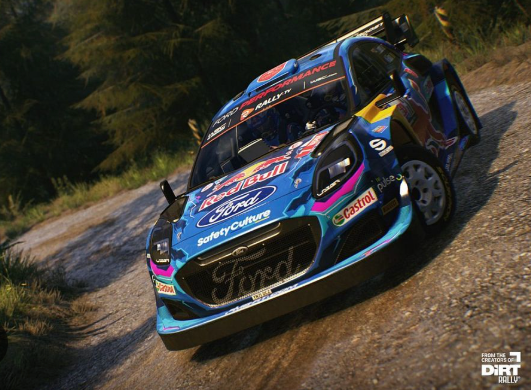
Simulation has blurred into reality minus the pain. I watch pros tearing through Swedish forests and fog-shrouded Japanese hillsides in real time—epic bravery, jaw-dropping skill. Reputation is everything. Spin out, hit a tree, and your digital soul shatters.
But the WRC warriors—the real ones—are still out there, risking it all. They’re pushing boundaries no simulator can replicate, especially the G-forces of slamming into something solid. Still, it’s more satisfying to hit “reset” after landing upside down in a ditch than to wait for a tow truck in real life.
We’ve evolved past the need to chase that adrenaline in flesh. Teenagers dominate global leaderboards, securing sponsorships for stunts they’ll never attempt outside a screen. Stadiums fill for million-dollar e-sports tournaments. This is hardcore with a virtually nonexistent chance of dying.
When the Real Becomes the Render
Something got lost when danger disappeared. In 1977, kids ran out of Star Wars screenings playing Jedi in parking lots. In the ’80s, we wielded multi-face dice to summon dragons. Today, disbelief isn’t suspended—it’s simulated. CGI and physics engines sculpt our reality to near perfection.
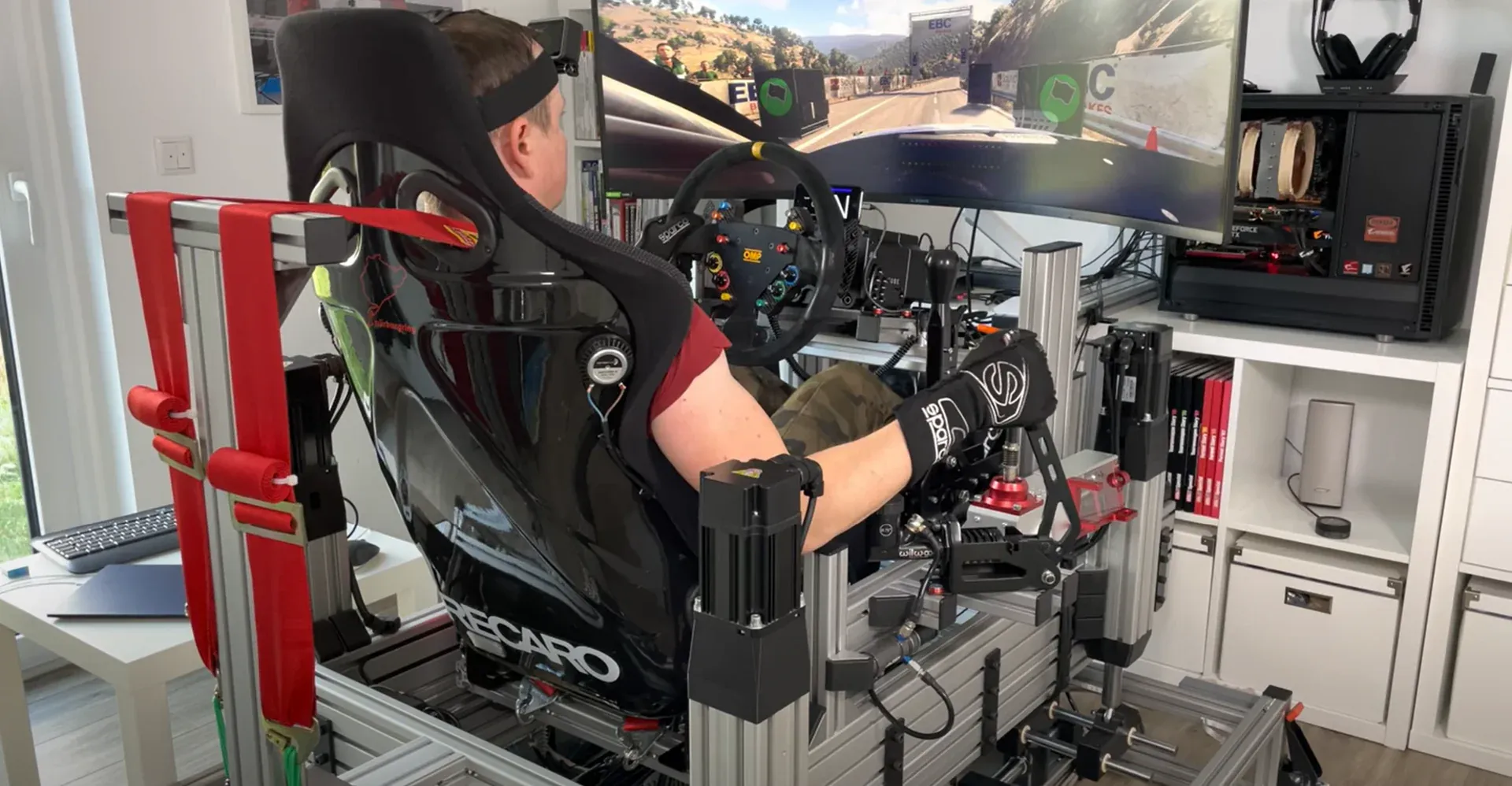
You don’t need VR to feel like you’re bombing down a rally stage. Simulation is enough. My 34-inch curved screen will be tomorrow’s dead tech, and a new portal will open. My Thrustmaster wheel and shifter are mid-level—nothing special but 100% sufficient. If I were given a thousand bucks to upgrade, I wouldn’t. I’ve plateaued.
Today’s simulators are so photorealistic, so physics-perfect, that real rally driving—man versus machine versus nature—feels almost unnecessary. The danger is captured in pixels. The physical realm no longer serves as the place to test multiple environments before lunch; only simulation can.
Since the WRC’s founding in 1972, there have been nineteen fatalities—seven drivers, twelve co-drivers. A small number compared with the miles driven, but every clip reminds you of the stakes.
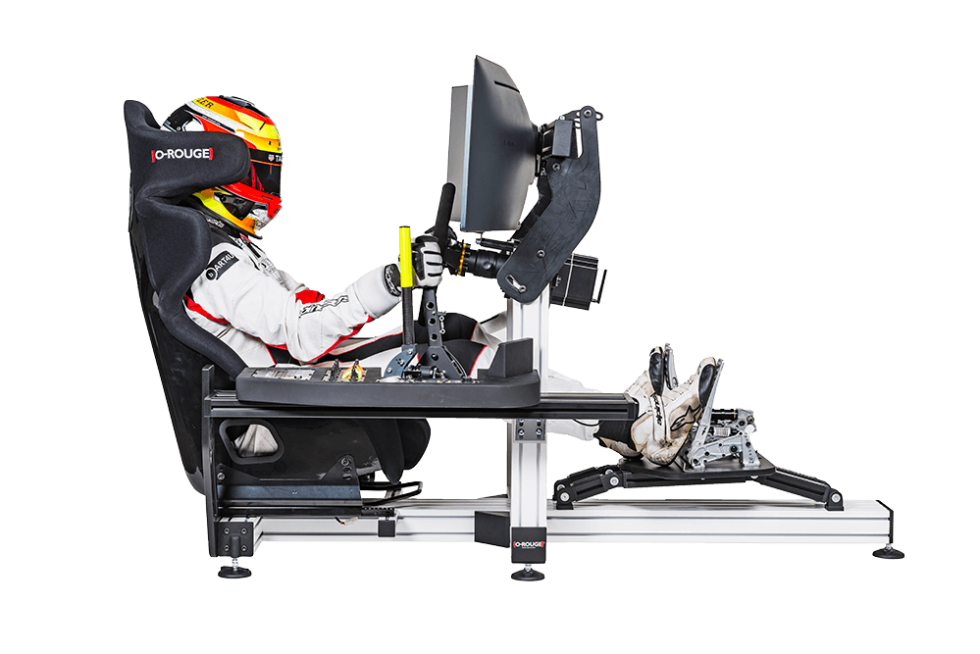
Today’s simulators are so photorealistic, so physics-perfect, that real rally driving—man versus machine versus nature—feels almost unnecessary. The danger is now captured in pixels. The physical realm no longer serves as the place to test multiple conditions in many environments before lunch; only simulation can satisfy that urge. Since the start of the WRC in 1972, there have been only 19 fatalities (seven drivers, twelve co-drivers). Compared with the miles driven, it’s a small number, but still—endless compilations of accidents remind you of the stakes.
The games reach an objective ambivalence for those of us who will never match the machinery of serious online gamers. Their scores and vehicular idolatry are beyond what most people will achieve. It wasn’t always so, but it is now. I gave up my subscription to NoHesi; it was too depressing to never get really good at anything. I’m a huge fan of Gooseist, who popularized drifting for many of us newbies, but even he is an elite master—too far to grasp with my meager skills.
In real life, I’ve driven in nineteen countries—from Armenia to Russia to Iraq—and I’m still getting wiped out online by fourteen-year-olds who’ve never driven a real car. I don’t want to be that good at anything. I can’t spend twenty hours a day practicing for a digital podium.
I still make the same errors racing as I did twenty years ago. I have a life outside gaming—and the violin. I just want to drive, virtual wrecks included.
Sometimes, I think, the real world still needs its moderate heroes, not just virtual legends.