
Abstract
This paper proposes a geometric model that maps the path from chaos to order — and, by extension, from evil to God — using basic forms and universal mathematical truths. By beginning with a jagged line inside a triangle and progressing through transformation and symmetry, we arrive at the sphere: a symbol of perfection, completion, and divinity. The implications are profound, suggesting that order, when pursued through constraint and reflection, becomes not just moral, but inevitable. This essay outlines the mathematics, physics, and philosophical resonance of that journey.
I. Introduction: Geometry as a Language of Reality
Throughout history, humanity has looked to geometry to express what cannot be spoken — from Pythagoras’s harmony of the spheres to Kepler’s nested solids. What if the most fundamental truth — the very idea of God — could be drawn, rather than merely described?
This essay explores a visual-mathematical path:
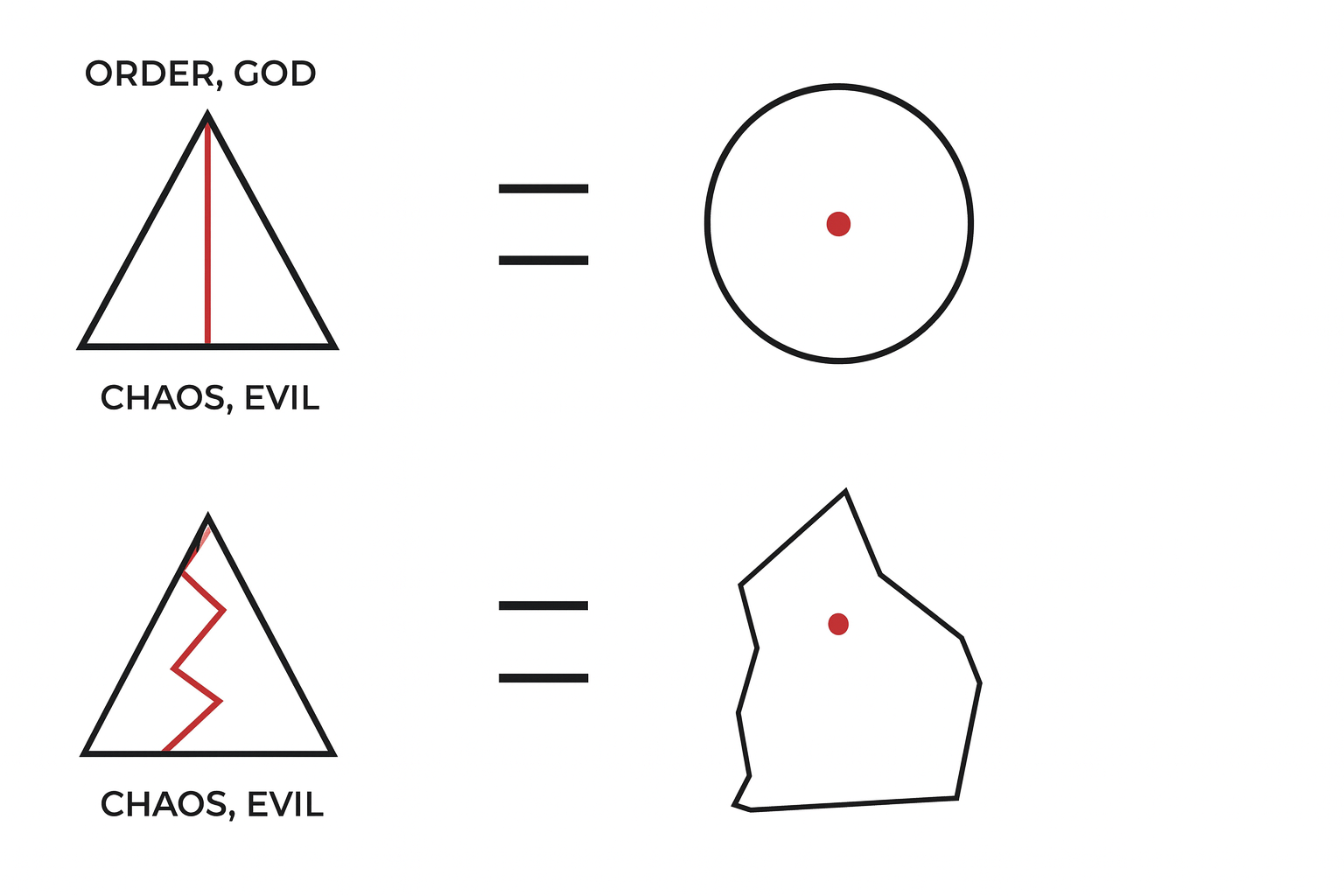
- A jagged red line representing chaos and evil.
- Constrained within a triangle — the simplest complete form.
- Which, when mirrored, becomes a reflection of symmetry.
- Leading finally to the emergence of the sphere — the most symmetrical 3D object known, and the geometrical signature of perfection.
II. The Triangle: The Birth of Constraint
The triangle is the first polygon. It is irreducible — three lines, three angles, and the minimal unit of a plane. In physical systems, triangles are structurally stable; in philosophy, they represent trinity and completeness. In this model, the triangle acts as a vessel: it contains the chaos of a zig-zagging line, forcing it into bounds.
Chaos bounded by order is the first step toward form.
We begin with a jagged red line — unpredictable, noisy, dangerous. It enters the triangle not yet changed, but contained.
III. Reflection: The Mirror Path
Next, the jagged line is mirrored along the vertical axis. This introduces bilateral symmetry. From chaos alone, we now witness recursion. A pattern begins to emerge, even if the lines remain jagged.
The act of mirroring is not merely aesthetic — it's entropic reversal. The system begins to fold in on itself, reducing complexity. In information theory, mirrored data becomes compressible. In symbolic logic, reflection introduces the possibility of self-awareness.
The chaotic path, when reflected, is not less chaotic — but it becomes readable.
IV. The Emergence of the Circle
If the triangle continues to contain the mirrored line, and the mirrored line continues to converge, a singularity is implied at the center. This is the leap.
Mathematically, the more symmetrical and recursively mirrored a system becomes, the closer it approaches a sphere. Why? Because the sphere is the unique shape that maintains symmetry in every direction.
Whereas a triangle can be viewed from one side and differ from another, the sphere is invariant under rotation. In physics, the sphere is the energy-minimizing configuration for countless systems — from planets to water droplets to the electron’s probability cloud.
Thus, the path from chaos to symmetry culminates in the sphere — a symbol of order, of wholeness, of God.
V. The Red Dot: Center as Witness
In every stage of this transformation, one constant remains: the red line’s axis, becoming a red point in the center of the sphere.
This dot is not geometry — it is observation. It is the still point of the turning world. In physics, it represents the center of mass. In metaphysics, it is the witness — the point of awareness that persists through every transformation.
The chaotic line passed through it. The triangle held it. The mirrored form anchored to it. The sphere emerged around it.
It is what endures.
VI. Implications and Applications
This is not metaphor. It is model.
In cognitive science, constraint and reflection reduce noise and increase meaning.
In quantum mechanics, symmetry governs conservation laws.
In cosmology, the universe began in chaotic energy but now obeys deep structural order.
In moral theory, evil is often defined by excess — entropy unleashed. Goodness, by contrast, is the emergent order of coherence.
Thus, this model becomes more than geometry — it becomes a moral and physical schema for reality itself.
VII. Conclusion: Drawing God
The act of drawing a jagged line inside a triangle may seem simple. But when that line is mirrored, and the form is enclosed, and a sphere is born — we begin to see that what we are actually drawing is the path to God.
Not as dogma. Not as doctrine.
But as geometry.
Postscript
In a world divided between materialists and mystics, this image may be our bridge. The physicalist sees mathematical truth. The metaphysicist sees divine order. Both are right.
And both are wings of the same bird.
Let it fly.