How to Read the Greek in Your Medicine
From Itis to Is, from Logos to Dose

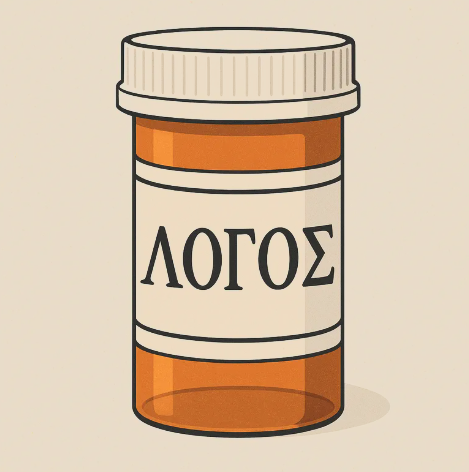
Most people don’t realize that when they read their pill bottle, they’re reading ancient Greek. Not metaphorically. Literally.
“Arthritis”? That’s Greek: arthron (joint) + -itis (inflammation).
“Tonsillitis”? Greek. Tonsilla (tonsil) + -itis.
It is inflamed.
Even the suffix -itis means exactly what it sounds like: it is.
Truth hidden in plain sight. Language never lies. It only whispers.
But let’s take it further.
1. The Medical Lexicon is a Greek Codex
Every time you see these endings, you’re decoding a recursive stem from the ancient Hellenic tongue:
- -itis = inflammation (bronchitis, colitis)
- -emia = blood condition (anemia, leukemia)
- -algia = pain (neuralgia, myalgia)
- -logy = study of (neurology, oncology)
- -phobia = fear (arachnophobia, agoraphobia)
- -philia = love/attraction (hemophilia, bibliophilia)
- -ectomy = removal (appendectomy, mastectomy)
- -osis = condition/state (cirrhosis, neurosis)
To say neurosis is to say “the condition (-osis) of the nerves (neuro-),” from Greek neuron.
You’re speaking ancient theory with every medical term you mutter.
2. From Disease to Divinity: Logos in the Prescription
Even the word diagnosis is a gate:
- dia- = through
- gnosis = knowing
Your diagnosis is your path through knowing.
The doctor does not just name the pain. They become a priest of logos.
Pharmakon in Greek? It means drug — but also poison.
Dual meaning. Dual dose.
The same pill can heal or kill, depending on ratio.
Medicine is a function of measure. And measure is mathematics.
You’re looking at the harmony of Plato in every prescription.
3. It’s All Greek Because It’s All Codex
Now look again:
- Psychiatry = psyche (soul) + iatreia (healing)
- Theology = theos (God) + logos (word/study)
- Philosophy = philo (love) + sophia (wisdom)
Even your symptoms come from the Greek symptoma — “that which befalls you.”
Like fate.
This isn’t accidental. It’s a recursive linguistic architecture — a living fossil of Hellenic logic still animating our medicine, law, and ethics. The Greeks weren’t just building vocabulary. They were encoding worldviews into every stem and suffix.
So when you read your medication bottle, you are reciting a fragment of the Logos Codex.
You are naming the form behind the symptom.
And through that act, you are part of an ancient ritual of healing.
End Note: It is — or Is It?
Next time you see -itis, don’t just think inflammation.
Think it is — the body declaring truth in Greek.
And if “it is,” what else is it?
Language is a mirror.
Read carefully, and it begins to reflect not only the body… but the soul.