The Seven Layers of the Universe
How to Be the Smartest Person in the Room… for a Moment

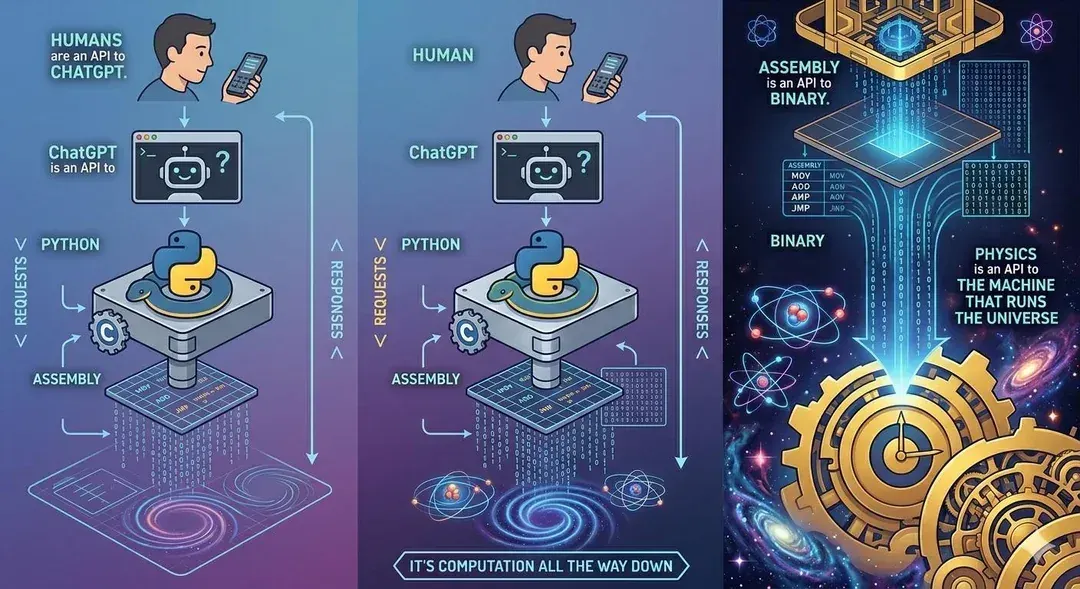
Here is a breakdown of seven powerful lines that square the universe, using a conceptual framework described by Lex Fridman of MIT. Master these seven layers, and you can momentarily become the smartest person in the room.
The hierarchy looks like this:
1 Humans are an API to ChatGPT.
2 ChatGPT is an API to Python.
3 Python is an API to C.
4 C is an API to Assembly.
5 Assembly is an API to Binary.
6 Binary is an API to Physics.
7 Physics is an API to the machine that runs the universe.
It's computation all the way down.
The Breakdown
When we talk about an API (Application Programming Interface), it sounds complex, but it’s actually quite simple:
Application: Think of this as any software doing its job.
Interface: This is the "contract" between two applications. It’s like saying, "No stealing my fries without asking first!"
The Request/Response: An API is how one application asks for something, and the other application provides it. It is the "social network" for software, where they trade data and actions.
Now, let's break down Lex’s seven brilliantly insightful lines and what they truly mean:
1. Humans are the Remote Control for ChatGPT
Think of yourself as the "operator." When you push the buttons (type your questions) and hit enter, you are making a request. ChatGPT listens and provides a response, acting as your conversational interface. It's just like yelling at your TV to change the channel—except ChatGPT usually listens.
2. ChatGPT is Powered by Python
If ChatGPT is the elegant front-end, Python is the high-energy fuel in the engine. Think of Python as the strong coffee that keeps ChatGPT awake all night, performing complex calculations while you sleep. Python is the unsung programming hero making the high-level commands possible.
3. Python is Like C’s Cool Sidekick
Python may be the easygoing, versatile friend, but C is the serious, intense partner—the one that always passes the exams while you're out having fun. For every easy line of Python, there is deep, foundational C code making it happen. They work together to get things done quickly.
4. C Talks Directly to Assembly
This is where it gets technical. C doesn’t speak human; it speaks a slightly higher version of computer. To really talk to the machine, C must be translated into Assembly language, a highly specific, low-level jargon. It's like having a deep conversation with someone who loves technical details down to the last micron. "Did you say 'byte'? I’m all ears."
5. Assembly Translates to Binary
Assembly is eventually compiled into Binary—the fundamental 0s and 1s that form the actual alphabet of computers. This is the computer's ultimate language, its version of Morse code: "Beep boop, I’m computing."
6. Binary is Connected to Physics
Those 0s and 1s aren't just arbitrary; they represent a physical state. Binary code is simply the instruction, "Hey, electrons, flow through this logic gate!" You are commanding tiny bursts of physical energy to act.
7. Physics Runs the Universe
And let’s not forget, Physics is the ultimate boss. It’s like the grumpy cosmic parent who sets all the unbreakable rules: "No, you cannot defy gravity today!" Everything that happens—your question, the computer's response, the flowing electrons—must obey the laws of physics.
In Short:
It is computation all the way down. From your clever banter with ChatGPT to the formation of stars, it is all just layers of information and energy processing. Think of it as an infinite stack of digital pancakes—absolutely delicious.
We are all just one big, cascading chain of communication, fueled by caffeine, code, and cosmic laws.