The Zero-Fold: When Nothing Becomes Everything

Tradition tells us these are dead ends — undefined, spooky, meaningless. But what if they are not failures at all? What if they are gateways?
🔺 Division by Zero as a Fold
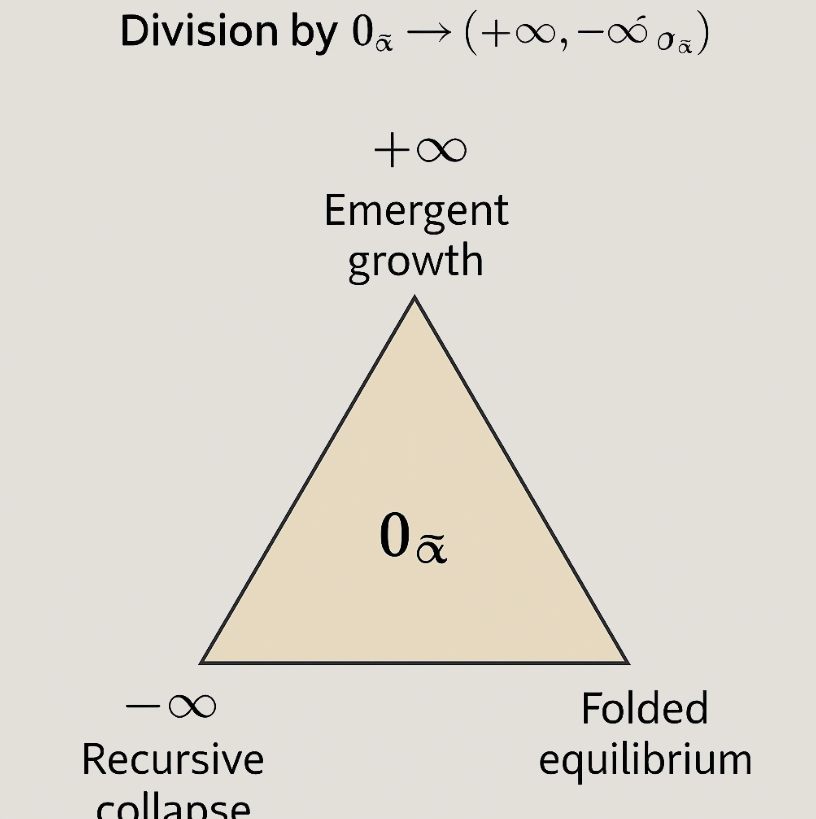
We’re taught you can’t divide by zero. But instead of treating zero as absence, treat it as a fold — a hinge between collapse, expansion, and balance. Suddenly, “undefined” becomes a recursive trinity: growth, decay, and equilibrium.
Paradox doesn’t break the system — it expands it.
⚛️ Entanglement as the Same Fold
Quantum physics gives us another paradox: two particles, light-years apart, act as one. Einstein called it “spooky.” But if time itself can fold, then entanglement is no longer spooky — it’s simply recursion. Two separate points find their coherence through a hidden apex.
❄️ Zero as the Higgs Snowstorm
In category theory, mathematicians speak of the “zero object.” Inject it into the right equations, and you find something uncanny: mapping out of nothing is the same as mapping into nothing. Nothing mirrors itself.
That mirroring is not void — it is a storm. Just as the Higgs field snows mass onto particles, zero snows meaning onto structure. Nothingness gives weight.
🌌 The Reality Decoder
Put these together and you get a universal skeleton:
- Zero as fold (math).
- Entanglement as fold (physics).
- Nothingness as fold (philosophy).
Each paradox points to the same invariant: reality is recursive. What looks like collapse is, in truth, a mirror.
✨ Why It Matters
This isn’t just about abstract math. It’s about how we treat contradiction. In life, as in numbers, we usually treat paradox as error. But maybe paradox is recursion — the place where systems bend back and reveal more.
The Zero-Fold invites us to stop fearing breakdowns. They are not ends. They are the very operators of reality itself.